

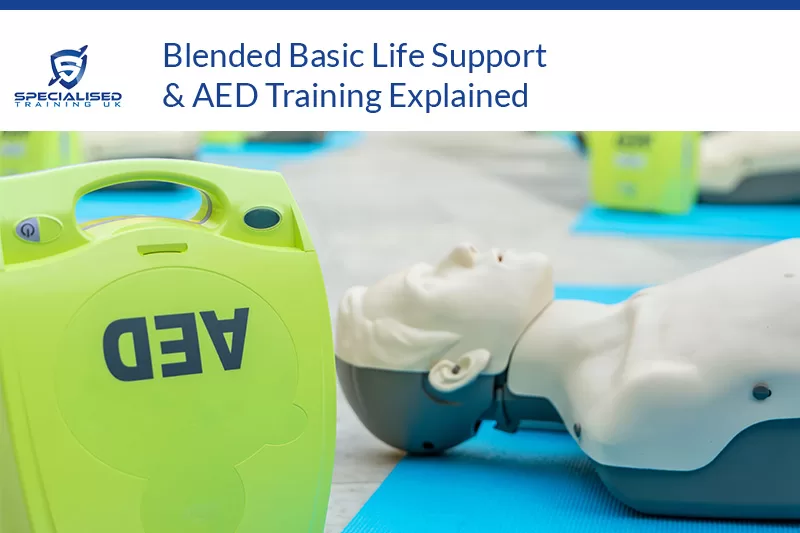
Emergencies rarely happen when it’s convenient or expected. That’s why confidence in basic life support skills can make a genuine difference while waiting for professional help to arrive. The new Basic Life Support and AED Blended course from Specialised Training UK is designed to make these essential skills more accessible, flexible, and practical for real-world situations.
What does “blended learning” mean?
Blended learning combines online theory with hands-on practical training. Learners complete the knowledge-based elements at their own pace online, then attend an in-person session to practise and demonstrate key life-saving skills.
This approach means participants can build understanding first, then focus on applying that knowledge in a supported, realistic environment.
What the course covers
The course includes a structured introduction to the core elements of basic life support:
- Primary survey
- How to quickly assess a casualty and identify life-threatening conditions
- Recovery position
- Safely placing an unconscious but breathing person
- CPR (Cardiopulmonary Resuscitation)
- Step-by-step guidance for non-breathing adults
- AED (Automated External Defibrillator) use
- How and when to use a defibrillator safely
Video demonstrations support key sections of the online learning, helping learners visualise each technique before practising it in person.
The practical element is delivered after successful completion of the online course, ensuring learners arrive with a solid foundation of knowledge ready to apply.
Why CPR and AED training is so important
Research consistently shows that early intervention saves lives. CPR alone can maintain circulation until emergency services arrive, but when combined with early defibrillation using an AED, survival outcomes increase significantly.
Some studies suggest survival rates can be around 9% with CPR alone before help arrives, rising to over 30% when an AED is used quickly, with improved neurological outcomes in many cases. These are not just statistics—they represent people in workplaces, schools, and communities where someone nearby had the confidence to act.
AEDs in everyday life
AEDs are becoming increasingly visible across the UK, from community centres and sports facilities to telephone kiosks and public buildings. While this growing access is encouraging, awareness and confidence are just as important as availability.
Many people have seen an AED in passing but are unsure what it does or how to use it. Training bridges that gap, turning hesitation into action when every second counts.
What learners say
Feedback from previous first aid training highlights the value of clear, engaging instruction:
“Fantastic instructor, learned more than what I thought I knew.” – Gary Sheehan
“Great presentation of the course and totally enjoyable.” – Lee Deadman
Building confidence to act
Knowing what to do in an emergency is one of the most valuable skills anyone can have. This blended course is designed to make those skills achievable, memorable, and ready for real-life situations.
For organisations and individuals alike, it’s not just training—it’s preparation that could make all the difference.
Contact us if you are interested in this blended course, or any of our other first-aid training courses:
01372 231 011 or 07787 504 622
Or email: info@specialisedtraininguk.com
Or use the contact form on this website.
First Aid courses:
We also offer half-day training courses on:
- Anaphylaxis Awareness and Auto Injector Training
- Automated External Defibrillator Training
- Basic Life Support Training.
Comments
Comments are closed.