


When we think about Immediate Life Support (ILS) training, it is easy to picture an A&E hospital ward or ambulance crew. But medical emergencies can happen in many different healthcare settings, and the people who may need to respond are not always working in a hospital.
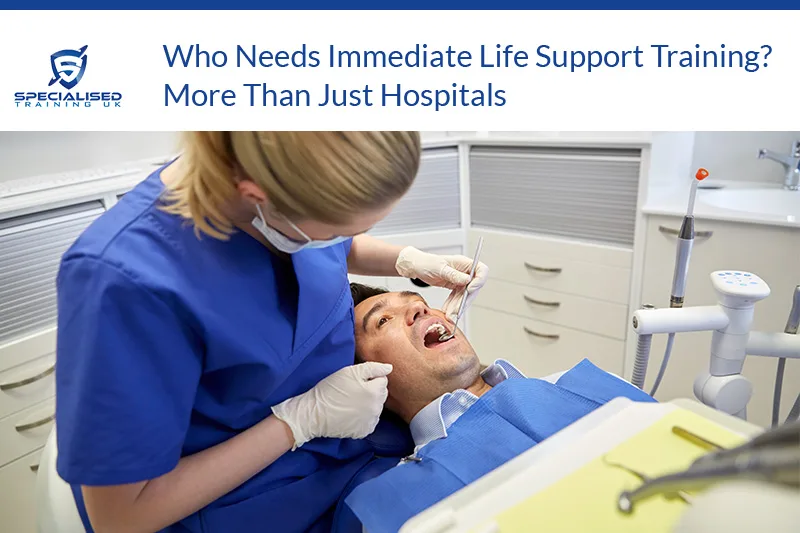
Dental practices are a good example
Although most appointments are routine, dental professionals need to be prepared to respond if a patient becomes seriously unwell. This is why Immediate Life Support training can be relevant to dentists and dental teams, as well as many other healthcare professionals.
The Resuscitation Council UK recognises dental professionals among those who can undertake Immediate Life Support training. Its guidance for primary dental care also highlights the importance of appropriate resuscitation arrangements and regular training.
For a dental practice, having the right equipment available is only part of being prepared. Staff also need to understand what to do if a patient’s condition suddenly deteriorates or they suffer a cardiac arrest.
Immediate Life Support training for dental teams
ILS training covers the practical skills and knowledge needed to recognise a deteriorating patient, respond to a cardiac arrest, perform effective CPR, use a defibrillator and work as part of a resuscitation team. For dental professionals, ILS can also contribute towards continuing professional development, with the course recognised by the General Dental Council’s Development Outcome C requirements.
The General Dental Council states that, “registrants must know their role in the event of a medical emergency and ensure they are sufficiently trained and competent to carry out that role.” [https://standards.gdc-uk.org/]
Who else can benefit from ILS training?
Immediate Life Support is designed for a range of healthcare professionals who may be expected to respond to a medical emergency. Depending on their role and workplace, this can include doctors, nurses, healthcare assistants, nursing associates, physiotherapists, radiographers and other healthcare professionals. The important point is that an emergency does not necessarily happen in a hospital. Patients can become unwell in GP surgeries, dental practices, clinics, care settings and other healthcare environments. Having staff who know how to recognise an emergency and respond quickly can make a significant difference while further medical assistance is being arranged.
How often does ILS training need to be refreshed?
Immediate Life Support is not something that should simply be completed once and forgotten about. Resuscitation Council UK recommends regular refresher training, and its ILS provider certificate is valid for one year. Regular training also provides an opportunity to practise practical skills such as CPR and defibrillation. These are skills that can become less familiar if they are not used regularly. For healthcare providers, keeping training up to date should therefore form part of their wider approach to emergency preparedness and staff development.
Looking for Immediate Life Support training?
Whether you are responsible for a dental practice, healthcare organisation or another setting where staff may need to respond to a medical emergency, Specialised Training UK provides Immediate Life Support training for healthcare professionals, with courses designed to develop the knowledge and practical skills needed to respond effectively in an emergency.
If your team needs to refresh its ILS training, or you are looking for training for a new group of staff, get in touch:
- 01372 231 011 or 07787 504 622
- Or email: info@specialisedtraininguk.com
- Use the contact form on this website.
Glowing Reviews for Our Training
“Very thorough presentation and very interactive.” Jade Marney
“Tony has been great with in-depth knowledge in the field of training, sharing realistic incidents and resources.” Waku Baah Gyebi
“Incredibly helpful and informative. Polite and respectful teaching while maintaining compassion and care. Very helpful tactics, confidence-boosting and assurance.” Layla
Comments
Comments are closed.